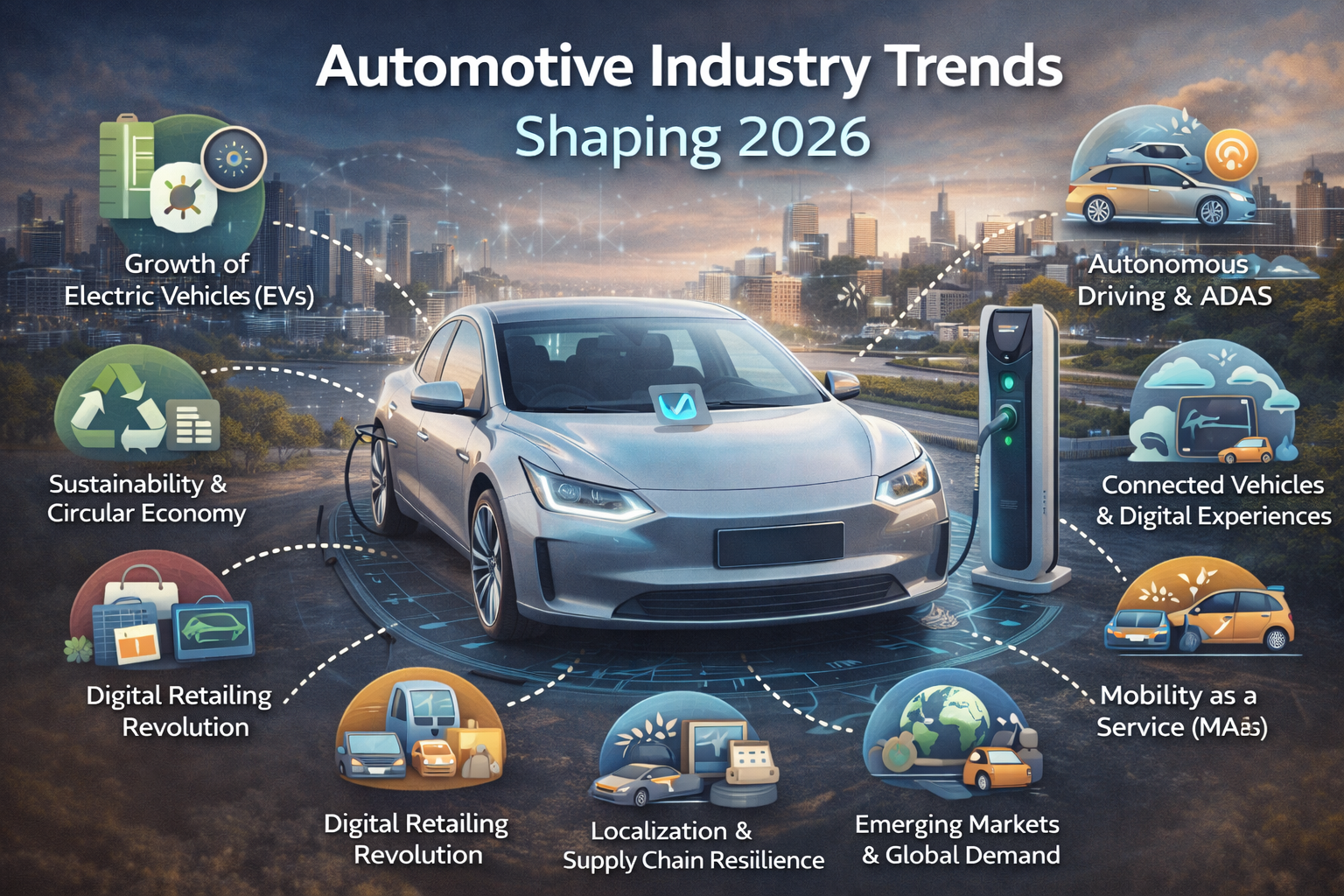
Automotive Industry Trends Shaping 2026
The automotive industry is undergoing one of the most transformative periods in its history. Emerging technologies, changes in consumer behavior, environmental pressures, and global economic shifts are driving innovation at an unprecedented pace. As the world approaches 2026, several clear trends are shaping the future of mobility—from electric vehicles and autonomous systems to digital retailing and sustainability commitments.
To remain competitive and relevant, manufacturers, suppliers, policymakers, and consumers alike must understand these trends and their implications. Below, we explore the key developments that are redefining the automotive ecosystem in 2026.
1. The Rise of Electric Vehicles (EVs)
Electric vehicles continue to dominate the automotive landscape. Advancements in battery technology, increased driving range, broader charging infrastructure, and more affordable EV models have accelerated electric adoption worldwide. Governments and regulatory authorities are also pushing for cleaner transportation through emissions standards and incentives for zero-emission vehicles.
Consumers are increasingly choosing electric powertrains for their environmental benefits and lower cost of ownership over time. Automakers are responding by expanding their EV portfolios, announcing new models across passenger cars, SUVs, and even commercial vehicles. As a result, EV market share is expected to grow substantially by 2026 as electric options become mainstream rather than niche products.
2. Advancements in Battery Technology
Central to the EV revolution is battery innovation. In 2026, improvements in battery energy density, charging speed, cost reduction, and thermal stability are critical priorities.
Lithium-ion batteries remain the core technology, but solid-state batteries and next-generation chemistries are progressing toward commercial viability. These new batteries aim to offer higher energy density—meaning longer driving range with less weight—while also enhancing safety.
Faster charging capabilities also support widespread EV adoption. Reducing the time required to recharge makes electric driving more convenient and comparable to refueling internal combustion vehicles.
3. Autonomous Driving and Advanced Driver Assistance Systems (ADAS)
Autonomous driving technology is another major trend reshaping the automotive industry. While fully self-driving cars are not yet commonplace, advanced driver assistance systems are rapidly improving and becoming standard features on many new vehicles.
ADAS includes technologies such as adaptive cruise control, lane-centering assistance, automated emergency braking, and traffic sign recognition. These systems enhance safety and reduce driver fatigue by automating certain driving tasks.
In 2026, many vehicles will feature increasingly sophisticated semi-autonomous capabilities, and ongoing testing of fully autonomous vehicles continues in controlled environments. These developments signal a future where automated mobility plays a central role in transportation.
4. Connected Vehicles and Digital Experiences
Connectivity is no longer a luxury; it is an expectation. Modern vehicles increasingly resemble mobile devices on wheels, equipped with advanced connectivity features that enhance safety, comfort, and user engagement.
Connected vehicles can communicate with infrastructure, other vehicles, and cloud services to provide real-time traffic updates, predictive maintenance alerts, and remote diagnostics.
Over-the-air software updates allow vehicles to receive feature enhancements without a dealership visit, similar to how smartphones update.
Digital interior experiences—such as personalized infotainment, voice assistants, digital keys, and app integrationare becoming differentiators for automotive brands aiming to attract tech-savvy consumers.
5. Sustainability and Circular Economy Practices
Environmental responsibility is a driving force in automotive strategy. Beyond reducing tailpipe emissions through electrification, manufacturers are embracing sustainability across the entire lifecycle of vehicles.
Sustainable practices include:
-
Use of recycled and bio-based materials in interiors and exterior components
-
Reduction of waste in manufacturing processes
-
Implementation of renewable energy at production facilities
-
End-of-life recycling programs for batteries and vehicle materials
Consumers increasingly demand transparency about environmental impact. Automakers that adopt circular economy principles—not just emissions reductions—are better positioned for long-term success.
6. Digital Retailing and Omnichannel Buying Experiences
The way vehicles are purchased is changing significantly. Traditional showroom sales are being complemented—and sometimes replaced—by digital retail experiences.
Customers can now research, customize, and even complete vehicle purchases online. Virtual showrooms, digital configurators, and online finance options create a seamless buying journey from home or mobile devices.
Even after purchase, digital interactions remain important. Many brands offer digital service bookings, mobile payments for maintenance, and remote support applications.Blending online and offline touchpoints—known as omnichannel retailing—enhances convenience and meets evolving consumer expectations.
7. Mobility as a Service (MaaS)
Mobility trends are shifting from ownership toward access and utility. Younger generations, urban dwellers, and cost-conscious consumers increasingly explore alternative mobility formats.
Mobility as a Service (MaaS) encompasses ride-hailing, car subscription models, short-term rentals, shared vehicles, and micro-mobility options such as scooters and e-bikes.
These services reduce the need for personal vehicle ownership while offering flexibility and convenience. Cities with traffic congestion and limited parking capacity benefit from shared mobility solutions that reduce private cars on the road.
By 2026, MaaS models are expected to expand, supported by integrated platforms that combine multiple transportation services into a single user experience.
8. Focus on Safety and Regulatory Compliance
Vehicle safety remains a top priority, with ongoing improvements in crash avoidance technologies and occupant protection systems. Regulators worldwide are updating and harmonizing safety standards to reflect modern capabilities such as ADAS, connectivity, and autonomous features.
Advanced sensor suites—such as radar, lidar, and camera arrays—enhance overall vehicle perception and safety. Crash test standards are also evolving to better assess real-world performance.
Manufacturers must balance innovation with compliance, ensuring that new technologies meet both legal and consumer safety expectations.
9. Resilient Supply Chains and Localization
Recent global disruptions highlighted vulnerabilities in automotive supply chains, particularly for semiconductors and key components. As a result, manufacturers are investing in supply chain resilience, including diversification of suppliers and increased localization.
Building regional manufacturing capacity reduces dependence on distant suppliers and enhances responsiveness to market demand. Strategic stockpiles of key materials, collaborative supplier relationships, and advanced forecasting systems also contribute to improved resilience.
Localized supply chains help reduce transportation emissions and support local economies while enhancing flexibility.
10. Emerging Markets and Global Demand Shifts
Automotive demand is not uniform across the globe. Emerging markets in Asia, Africa, and Latin America present significant growth potential due to expanding middle classes and increased mobility aspirations.
As demand grows in developing regions, manufacturers are tailoring products to local preferences and affordability. Compact vehicles, cost-effective EV models, and service innovations tailored to regional realities are part of expanding global reach.
Understanding cultural nuances and economic conditions enables brands to remain competitive in diverse markets while driving global growth.
Conclusion
The automotive industry of 2026 will be shaped by innovation, sustainability, consumer expectations, and technological advancement. Electrification, connectivity, autonomous features, and digital experiences are no longer futuristic ideas but active priorities in today’s automotive landscape.
Consumers benefit from safer, smarter, and more environmentally responsible vehicles. Manufacturers that embrace transformation—while remaining attentive to cost, safety, and market dynamics—will thrive in this era of rapid change.
As global mobility continues to evolve, the industry trends shaping 2026 reflect a future where transportation is cleaner, smarter, more connected, and aligned with broader societal needs. Whether through electric powertrains, seamless digital experiences, or flexible mobility solutions, the automotive industry is accelerating toward a more innovative and sustainable tomorrow.
activeathens.com activeathens.com activeathens.com activeathens.com activeathens.com activeathens.com activeathens.com activeathens.com activeathens.com activeathens.com activeathens.com activeathens.com activeathens.com activeathens.com activeathens.com activeathens.com activeathens.com activeathens.com activeathens.com activeathens.com activeathens.com activeathens.com activeathens.com activeathens.com activeathens.com activeathens.com activeathens.com activeathens.com activeathens.com activeathens.com activeathens.com activeathens.com activeathens.com activeathens.com activeathens.com activeathens.com activeathens.com activeathens.com activeathens.com activeathens.com activeathens.com activeathens.com activeathens.com activeathens.com activeathens.com activeathens.com activeathens.com activeathens.com activeathens.com activeathens.com activeathens.com activeathens.com activeathens.com activeathens.com activeathens.com activeathens.com activeathens.com activeathens.com activeathens.com activeathens.com activeathens.com activeathens.com activeathens.com activeathens.com activeathens.com activeathens.com activeathens.com activeathens.com activeathens.com activeathens.com activeathens.com activeathens.com activeathens.com activeathens.com activeathens.com activeathens.com activeathens.com activeathens.com activeathens.com activeathens.com activeathens.com activeathens.com activeathens.com activeathens.com activeathens.com activeathens.com activeathens.com activeathens.com activeathens.com activeathens.com activeathens.com activeathens.com activeathens.com activeathens.com activeathens.com activeathens.com activeathens.com activeathens.com activeathens.com activeathens.com activeathens.com activeathens.com activeathens.com activeathens.com activeathens.com activeathens.com activeathens.com activeathens.com activeathens.com activeathens.com activeathens.com activeathens.com activeathens.com activeathens.com activeathens.com activeathens.com activeathens.com activeathens.com activeathens.com activeathens.com activeathens.com activeathens.com activeathens.com activeathens.com activeathens.com activeathens.com activeathens.com activeathens.com activeathens.com activeathens.com activeathens.com activeathens.com activeathens.com activeathens.com activeathens.com activeathens.com activeathens.com activeathens.com activeathens.com activeathens.com activeathens.com activeathens.com activeathens.com activeathens.com activeathens.com activeathens.com activeathens.com activeathens.com activeathens.com activeathens.com activeathens.com activeathens.com activeathens.com activeathens.com activeathens.com activeathens.com activeathens.com activeathens.com activeathens.com activeathens.com activeathens.com activeathens.com activeathens.com activeathens.com activeathens.com activeathens.com activeathens.com


Comments
Post a Comment